Busyness as Laziness
Today I learned something unexpected. A type of laziness: excessive busyness. Or in a more refined phrase: business as laziness.

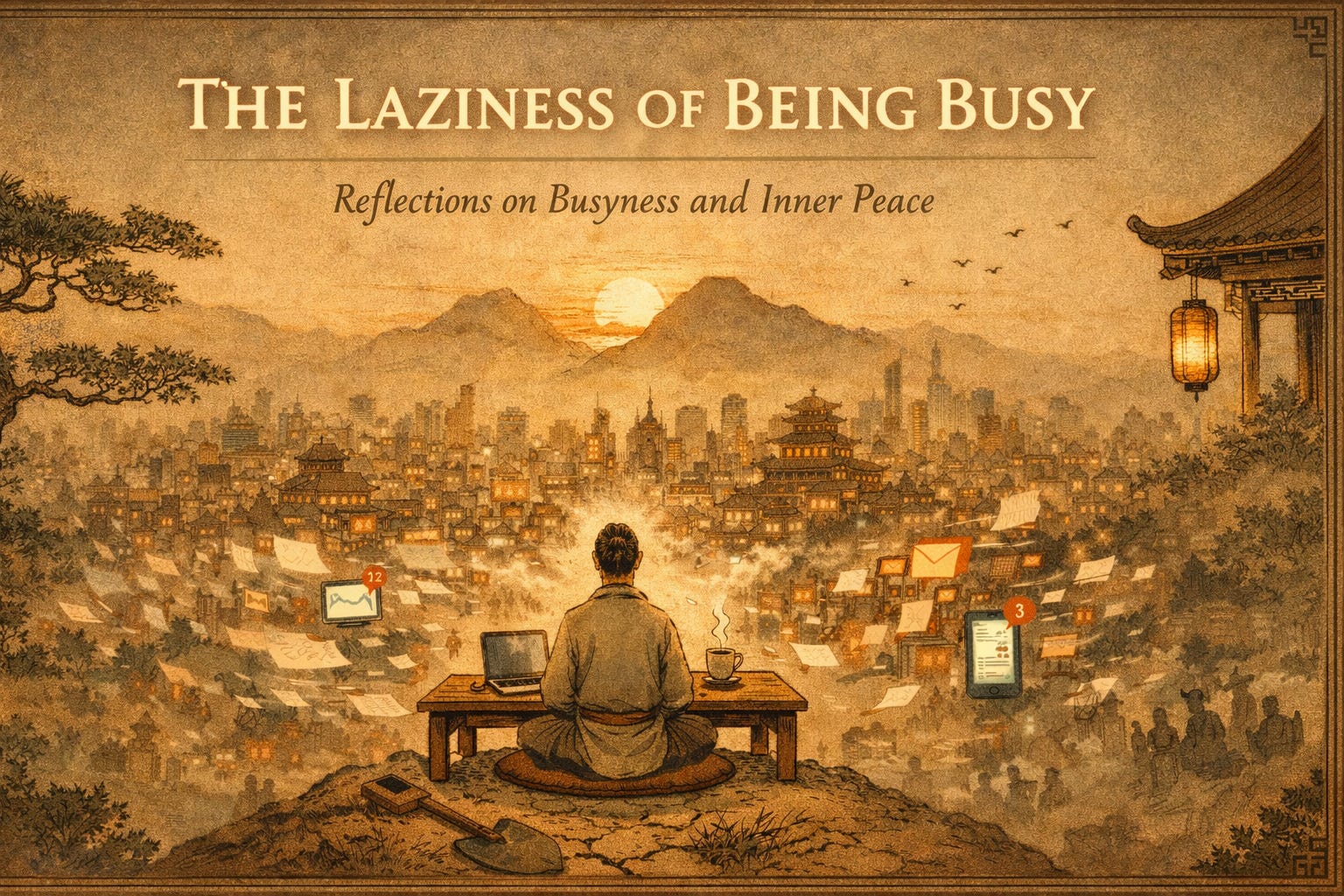
When being constantly busy becomes a subtle form of laziness
Today I learned something unexpected.
A type of laziness: excessive busyness.
Or in a more refined phrase: business as laziness.
If someone had simply told me “you are lazy,” I probably would have been offended. But sometimes when a truth is expressed in a more thoughtful and nuanced way, you can receive it not as a slap in the face but as a moment of inspiration.
Especially when the idea reveals the deeper root causes, rather than just labeling the surface behavior.
Today I realized something uncomfortable:
Yes, I am lazy.
A Buddhist Perspective on Laziness
While listening to Angie Lee-Foster’s course The Art of Slowing Down, one of the final lessons mentioned something fascinating: in Buddhism, there are different types of laziness.
You can find the link to the course at the end of this article—I strongly recommend it.
The fact that laziness has been categorized in Buddhist thought tells us something important:
This problem has been known for thousands of years.
The Busyness Trap
Think about a typical modern day.
You are constantly doing something.
You are:
writing
answering messages
calling someone
being called
checking notifications
responding to “urgent” or “critical” requests
Meanwhile, life continues in the background:
eating
drinking
handling daily responsibilities
By the end of the day, you feel exhausted.
And yet something interesting has happened:
You have done nothing spiritual.
By spiritual I do not mean lighting incense or performing rituals.
I mean something much simpler and much harder:
being alone with yourself
thinking deeply
facing your discomfort
allowing difficult inner conversations to exist
Most people want to do this.
But they postpone it.
Sometimes they even do it—but only mechanically, just to say they did.
How My Day Usually Starts
In my own case, this process often begins very early in the morning.
Sometimes it starts the night before with long to-do lists.
Then I begin my day using a productivity method I have practiced for years and benefited greatly from: time-boxing.
But very soon, the interruptions begin.
The WhatsApp bombardment.
Relentless.
Non-stop.
And often unnecessary.
Most of these messages come from colleagues experiencing their own morning stress. Instead of sitting down and focusing, they send a simple question as five separate messages, creating five separate notifications.
For them, it brings temporary relief.
But the stress gets transferred to me.
(For the record, this does not include “good morning” messages or thoughtful inspirational content.)
The Collapse of Time-Boxes
Soon my carefully designed time-boxes begin to fall apart.
And then something predictable happens.
The short meditation session I planned for the day gets postponed.
Suddenly it is already lunchtime.
In the afternoon, the same stress returns—but stronger.
Now it appears in the form of meetings.
Endless meetings.
Often I can sense their inefficiency from the way they are organized.
Sometimes ten people spend an hour discussing the wording of a single sentence on a page.
Meanwhile the recipient of that document will probably skim it quickly and move on.
But the same document might contain five tasks that each require at least ten hours of focused work.
For those tasks, of course, there is never enough time.
The rest of that story is for another day.
Spiritual Laziness
This is what spiritual laziness looks like.
You keep working endlessly and assume progress is happening.
And in many ways, it actually is.
Results appear over time.
But instead of letting those results mature, you try to get more by doing even more.
This is like watering a tree excessively because you want it to produce more flowers.
But nature does not work that way.

A Memory From Childhood
I remember doing exactly this as a child.
I watered a small sapling too much.
Eventually, it died.
The soil had turned into mud.
Even plants that could survive harsh conditions could not grow there anymore.
Then our elderly gardener neighbor explained something simple.
“The soil does not need more water.
It needs space.”
Space.
I took a shovel and loosened the soil around the tree.
I allowed air to enter the earth.
Eventually the soil recovered.
The Same Thing Happens in Our Lives
We often do the same thing to ourselves.
We keep watering the tree.
But we fail to notice that the soil inside us has become suffocated.
At some point our roots can no longer absorb even the water we are given.
Sometimes what we need is a gardener’s intervention.
But that gardener is often simply this:
Stopping.
Creating real space.
And you know what that space often is?
Meditation.
Why Space Feels So Difficult
Cal Newport, a writer I admire, explores productivity deeply in his book Slow Productivity.
Through careful arguments and thoughtful reasoning, he explains many problems of modern work culture.
But the experience of space that meditation provides is sometimes hard to capture through logic alone.
Why?
Because meditation allows something natural to happen.
It allows the water already flowing inside us to slowly reach the deeper layers of our being.
What Meditation Actually Is
The word meditation comes from Latin and means to think deeply.
When I first took meditation lessons, I was taught not to suppress thoughts, but to let them go.
At first I thought this was nonsense.
How could not thinking possibly lead to deeper thinking?
But over time I realized something.
Meditation is not about eliminating thought.
It is about giving rest to the famous monkey mind.
The Monkey in the Passenger Seat
Inside our minds there is always a monkey.
Imagine it sitting in the passenger seat while you drive.
Sometimes it is helpful.
Occasionally it reminds you of something important.
But in modern life it mostly does something else:
It makes noise.
Endless noise.
And after a while you can no longer focus on the road.
That is the moment when the solution is surprisingly simple:
Stop.
Take a real break.
But not by scrolling your phone.
Take a break away from external stimulation.
A Small Suggestion
Looking for a simple way to pause?
Look out the window.
Just for a while.
Watch a bird.
Watch a cat.
Watch the wind moving through trees.
My guess is that you have not done that for a long time.
And perhaps that is exactly why you need it.
Dr. Suat ATAN